Book 2: Sunstone
Chapter 8: Sunstone
APOCALYPSE

$5 STICKERS
"I hear the ruin of all space, shattered glass and toppling masonry, and time one livid final flame. What's left us then?"
James Joyce
Life comes at us in cycles. Suns, Ages, Eras, little packets of time that pulse across space like waves of mountains. What seems solid and eternal will ultimately fall back into the sea. All things collapse only to rise up and be born again. This cycle has been mapped many times across many cultures, a pattern that endures and picks us up for another adventure.
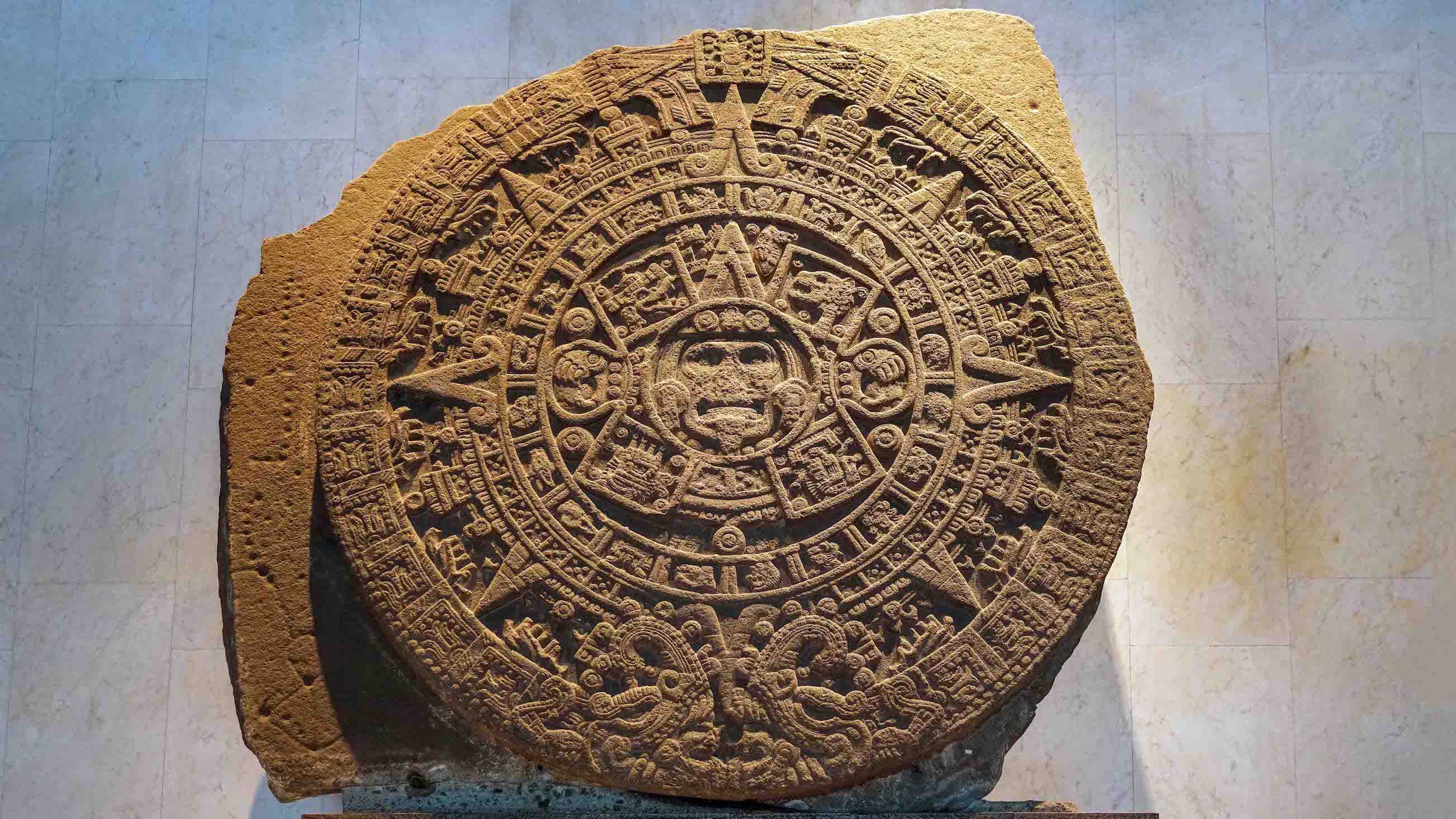
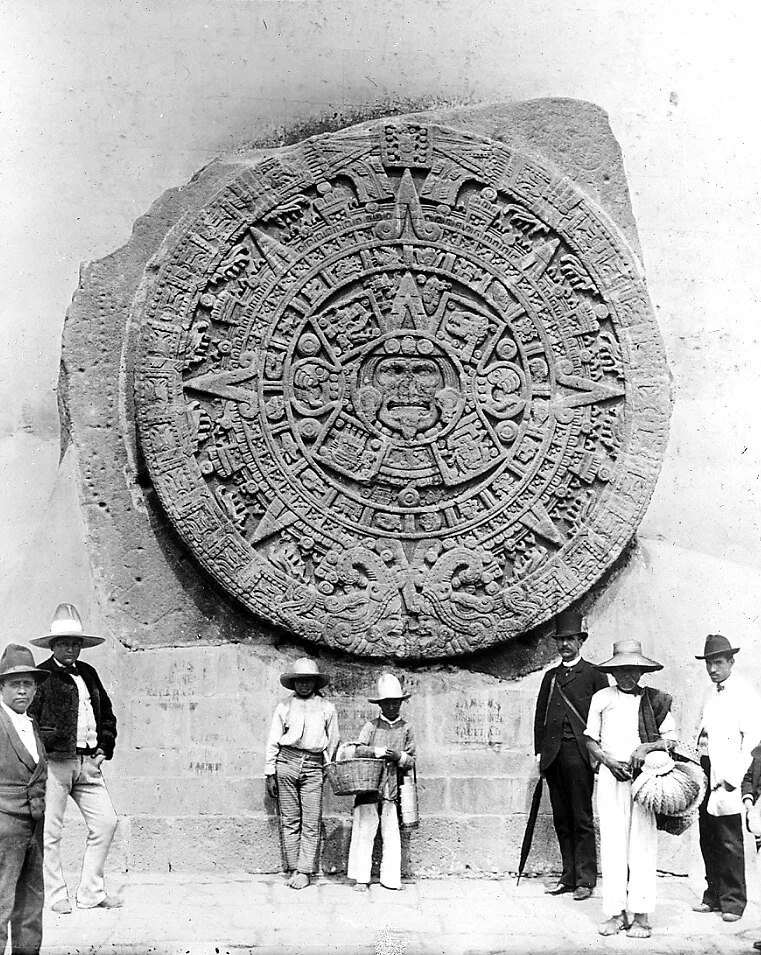
The Aztec Sunstone (Piedra del Sol), also called the Calendar Stone, is believed to have been carved out of basalt from the heart of Popocatépetl, the local volcano. It stands 12 feet (3.6 meters) tall and 3 feet thick and currently resides in Mexico City's National Anthropology Museum. It was discovered in 1790 in the Zócalo (main square) during repairs to the Metropolitan Cathedral in Mexico's capital.
"On the occasion of the new paving, the floor of the Plaza being lowered, on December 17 of the same year, 1790, it was discovered only half a yard deep, and at a distance of 80 to the West from the same second door of the Royal Palace, and 37 north of the Portal of Flowers, the second Stone, by the back surface of it."
— León y Gama, as cited by Chavero
The carving (artist unknown) is dated to the year 1479, 13 years before Columbus. The square at the top is believed to be the date of creation per the Aztec (Mayan) Calendar. It was not used as a calendar, however, but rather an altar used in ritual ceremonies dedicated to the Aztec pantheon, mostly sacrificial. When the Spanish conquered and subdued the Aztec Civilization and burned all their history, for unknown reasons they chose to bury the sunstone near the square sometime in the 16th century.
The Sunstone garnered a lot of fame, along with a great deal of misconceptions, during the Apocalyptic craze of December 21, 2012, when many thought the ending of the Mayan Calendar meant the ending of the world. It was simply the end of a cycle, and the beginning of the next.
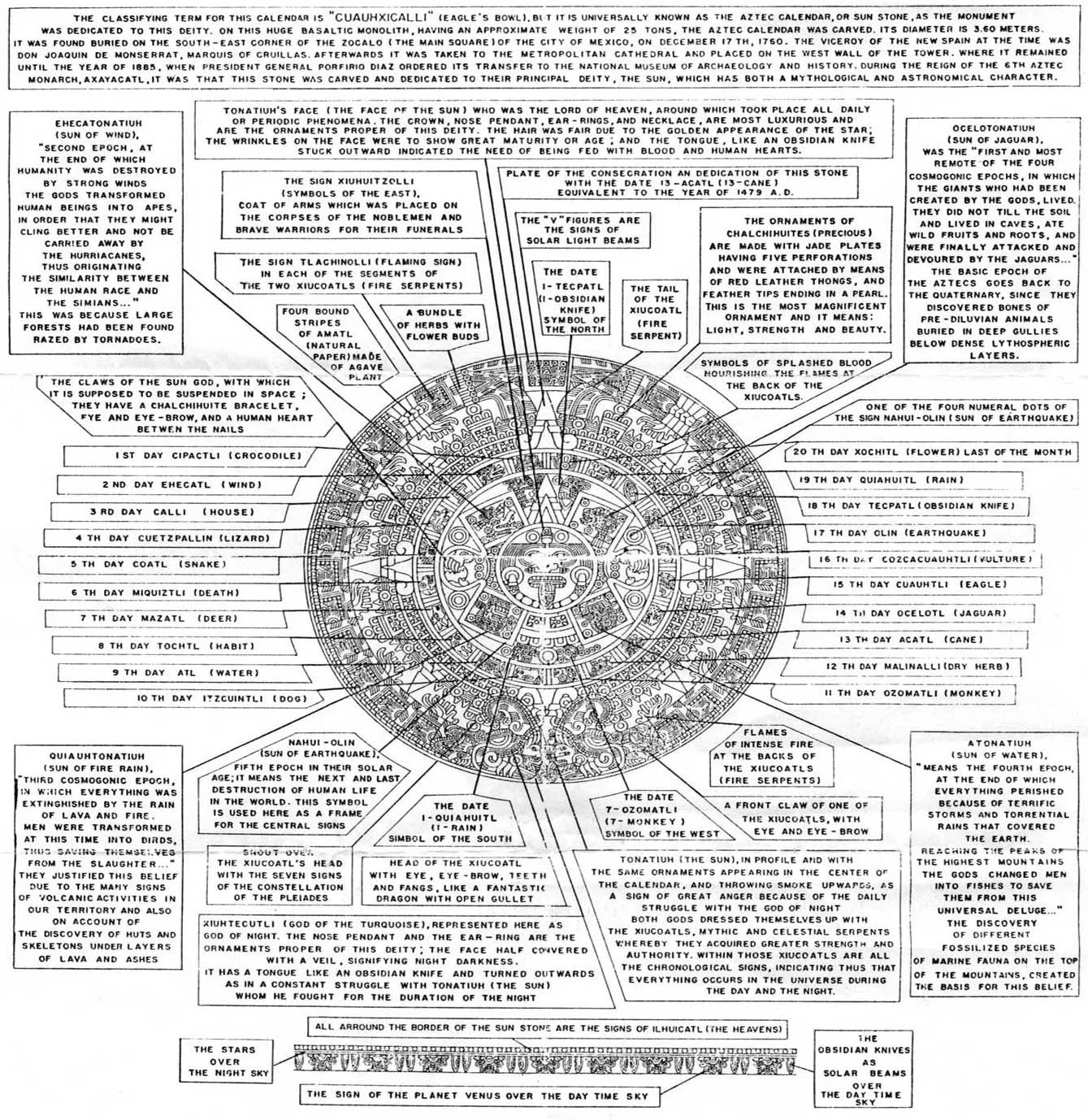
What is actually portrayed is a map to Aztec Cosmology. The Aztecs, along with the Maya, were advanced astronomers, and developed a clear vision for the cycles of the Solar System and Universe. It illustrates their perception of the patterns they found themselves in and how the related to the cycles.
In the center circle, the 5 Suns are represented, interpreted as Universes (Eras), of which we are currently in the 5th Sun of Movement (center). The next ring represents the 20 days in the Aztec (Mayan) Calendar. The following concentric rings I interpreted as patterns representing the elements (forces) in our current Universe. The outer rings are that of Xiuhteculti (God of Night) and Tonatiuh (God of the Sun). The outer-outer ring is a reflection of the patterns on the sides which represent the Heavens. (see map below)
For Mexico, La Piedra del Sol has become to mean more than just an ancient artifact, it is a living symbol of national and cultural pride connecting them to their pre-Columbian heritage. In many ways, it has become the cornerstone for the soul of Mexico.
I painted this piece during the Crash of 2008 when the entire architectural and construction industry evaporated. All of my clients went out of business within a month (March) and I spent the rest of the year working on Sunstone trying to figure out how to restart my life. In a way, it helped me through my own little Apocalypse.
“We have come to your house in Mexico as friends.
There is nothing to fear.”
Hernando Cortés